10 Ways to Build Inclusive Classrooms
When people talk about diversity, inclusion and quality education, it’s easy to imagine these ideas as large, abstract concepts. In reality, they take shape in everyday classroom habits—small things that teachers and students do that help everyone feel welcome, respected, and able to learn. A diverse and inclusive classroom is the result of intentional practices and shared values.
Here are ten practical inclusion rules that create space for every type of learner.
1. Respect all differences
Respect can mean different things depending on the situation. In a classroom, it often means noticing and valuing the ways people are different. These could be differences related to culture, language, learning style, or personality.
For example, if one student wears clothing from their culture, classmates can show interest by asking polite questions rather than making jokes. Teachers can also help by sharing stories or short videos that highlight different traditions, so students see diversity as something to learn from rather than to judge.
2. Listen when others speak
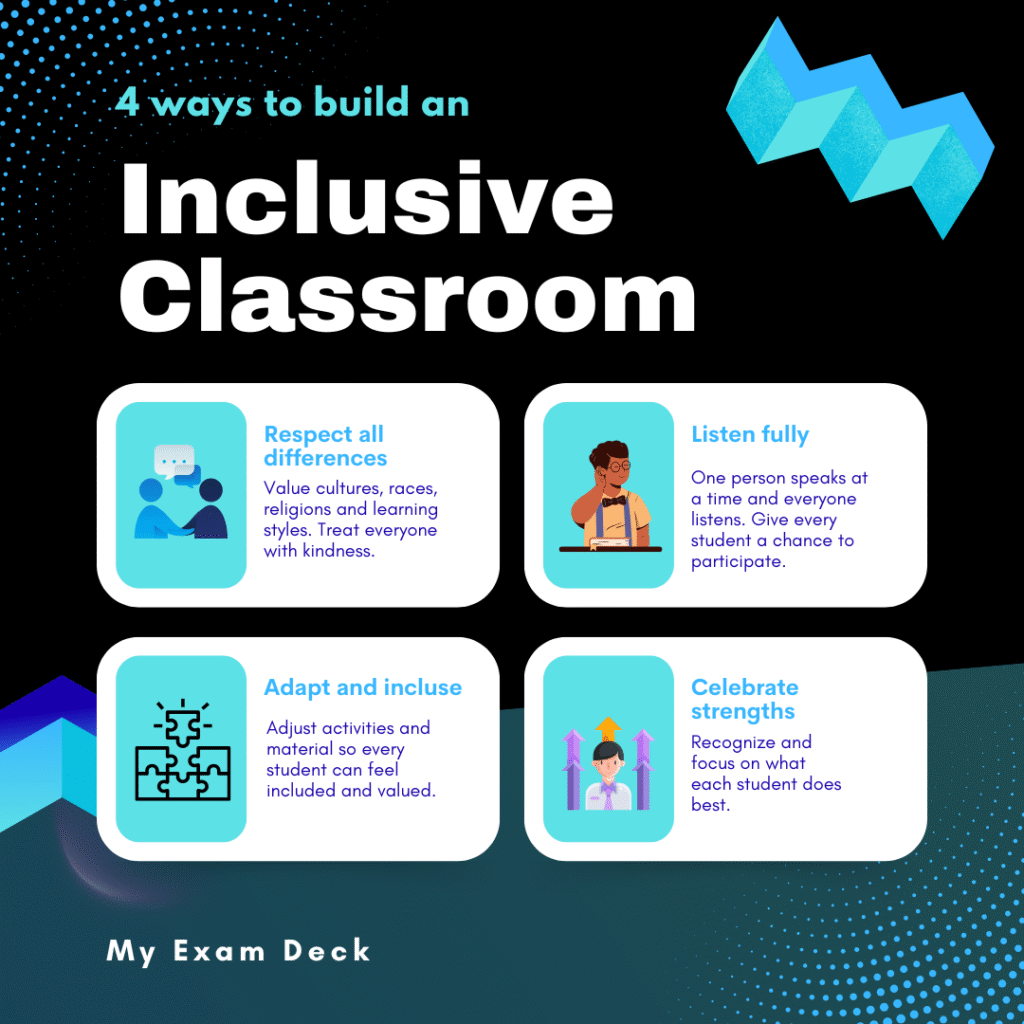
Listening means giving your full attention to the person speaking, whether it’s the teacher explaining a new concept or a classmate sharing an idea in group work.
A practical approach could be establishing a “one voice at a time” habit. For instance, during a discussion about a story, the class pauses after each student speaks. This small gap of silence encourages careful listening and avoids people talking over each other. It may seem slow at first, but it often leads to richer conversations.
3. Use inclusive language
Language shapes how people feel in a group. In an inclusive classroom, students and teachers try to avoid words that might exclude or hurt others. This could be as simple as learning to pronounce a classmate’s name correctly or avoiding jokes that target someone’s background or abilities.
One teacher I know keeps a “language wall” where students suggest respectful alternatives to phrases that might hurt. For example, instead of saying “That’s weird,” they might say, “That’s different from what I’m used to.” Over time, this practice creates a culture where words are chosen more carefully.
4. Everyone has the tight to learn
Every student comes to class with the hope of learning something new. An inclusive environment recognizes that not everyone learns at the same speed or in the same way, this is especially true for neurodivergent leaners who may need additional support in the form of visuals, repetitions, reinforcements or extra time.
In group projects, this might mean giving roles that match each person’s strengths. One student might take notes, another might organise the information, and someone else might present the ideas. This way, everyone contributes without feeling left out or overwhelmed.
5. Give everyone a turn
Participation means everyone, even the quite students, get a chance to speak. Invite every student to share their views and ideas in discussions.
For example, in a science class, instead of calling on volunteers for every question, the teacher might use cards with each student’s name. This ensures quieter students also have a chance to speak, and the group benefits from a wider range of ideas.
6. Ask before you help
Helping is a kind gesture, but sometimes it can make someone feel like you doubt their ability. Asking first respects the other person’s independence.
Imagine a student with a visual impairment working on a drawing activity. Instead of taking the pencil and trying to “fix” their work, a classmate could ask, “Would you like me to help with the outline?” This keeps the control with the person receiving the help.
7. Use flexible thinking
Flexible thinking is the ability to see that there may be more than one right answer or more than one way to approach a task. It’s especially useful in diverse classrooms where students may solve problems differently.
In maths, for example, one student might solve a problem using mental calculations while another uses a diagram. Instead of insisting on one method, an inclusive teacher highlights both approaches on the board, showing that different strategies can lead to the same correct result.
8. Keep the environment safe
Safety covers both physical and emotional safety. Students need to know they can share ideas or make mistakes without being laughed at or punished, because mistakes are a part of learning.
One way to encourage this is by ensuring students resolve conflicts and disagreements through dialogue and non-violent means. There should be zero tolerance to bullying in class, and a strict culture of mutual respect and accountability has to be enforced by all teachers.
9. Adapt and include
Sometimes activities need small changes so everyone can take part. This could mean adjusting the rules of a game so a student who uses a wheelchair can join, or providing visual instructions for students who learn better through images.
For instance, in a physical education class, a running game could be adapted into a passing game so all students can participate at their own pace. These changes accommodate all types of students.
10. Celebrate strengths
Every student has something they do well, whether it’s academic, creative, athletic, or social. Celebrating these strengths helps build confidence and a sense of belonging.
A class could have a “strengths board” where students post achievements, which can be anything from completing a tricky maths problem to helping a classmate. This practice not only boosts self-esteem but also shows that success can look different for different people.
Special Feature: Making classrooms inclusive for neurodiverse students
Diversity in the classroom also includes differences in how students think, learn, and process the world. Neurodiversity is a term that covers variations like autism, ADHD, dyslexia, and others, and it reminds us that brains work in many different ways. An inclusive classroom takes this into account and makes adjustments so neurodiverse students can fully participate in learning.
Sometimes these adjustments are small but powerful. For example:
- Clear instructions: Giving written steps as well as verbal explanations helps students who may struggle to process spoken directions quickly.
- Sensory breaks: Allowing short breaks or a quiet corner can help a student who feels overwhelmed by noise or movement.
- Flexible deadlines: In certain cases, giving extra time for assignments can make the difference between frustration and success.
- Multiple ways to show learning: Instead of always using written tests, allow students to demonstrate knowledge through a project, a video, or an oral presentation.
Peer understanding is also key. Teachers can foster empathy by explaining, in age-appropriate ways, that everyone’s brain works differently. This helps prevent misunderstandings, like thinking a classmate is “not paying attention” when they’re actually focusing best while doodling.
Inclusion for neurodiverse learners means we offer them what they need to learn well.
Why inclusion matters
When we welcome diversity, we welcome a range of experiences, skills, and perspectives that each person brings with them. In a classroom, diversity becomes a strength when it is paired with inclusive practices that give everyone equal opportunities to learn and contribute.
Quality education, one of the Sustainable Development Goals, is not measured only by test scores. It also looks at whether each students feels capable, valued, and prepared to work with people who are different from them. By following simple inclusion rules, teachers and students create an environment where learning is shared, voices are heard, and differences are seen as assets.
Practical diversity & inclusions tips for teachers and students
- Start small. You don’t need to change everything at once. Begin with one or two inclusion rules and build from there.
- Model the behaviour. Teachers who consistently show respectful listening or use inclusive language set the tone for the class.
- Encourage reflection. Ask students what helps them feel included and what changes might make participation easier.
- Involve families. Sometimes inclusion at school is strengthened by understanding a student’s needs and strengths from home.
An ongoing journey
Inclusion is not something you practice at any one moment. Instead, it’s a continuous and dynamic process because what works for one class in one year might need adjusting for another group the next year.
The good news is that the effort pays off. Students who experience inclusion early are more likely to carry that respect for diversity into other parts of life, whether it’s in further education, the workplace, or their communities. And when classrooms model these habits, they contribute to the wider goal of quality education for all.